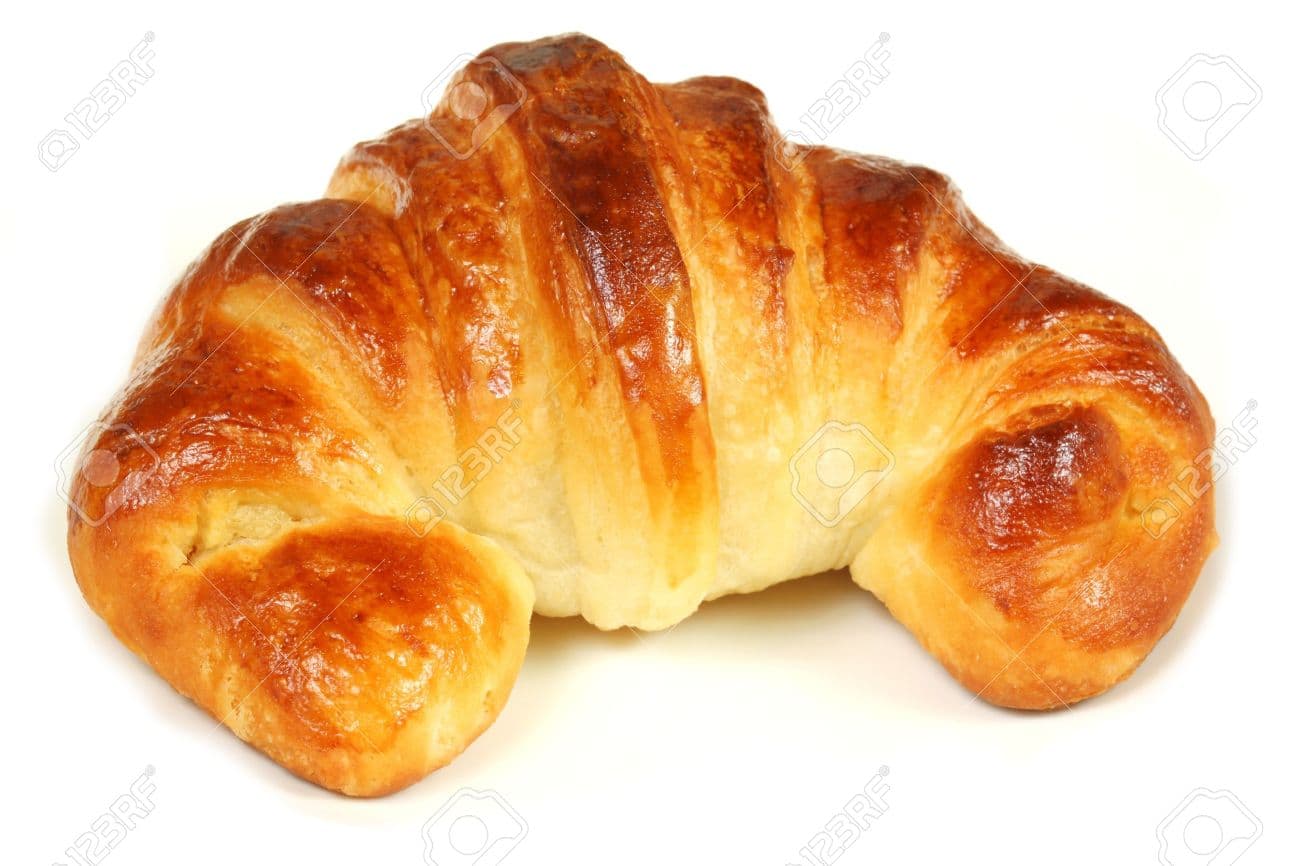
Traditional French Butter Croissant
Laminated yeast dough (PLF), 84% fat dry butter and translucent honeycomb crumb
Heritage & Historical Context
The butter croissant is the international crown jewel of French viennoiserie. Crafted from laminated yeast dough (PLF), it demands absolute thermal synchronization between dough and laminating butter. It delivers an ultra-crisp exterior and a melting, translucent honeycomb crumb.
Descended from the Austrian kipferl introduced to France by August Zang and Marie-Antoinette, it was reinvented by Parisian bakers in the early 1900s who swapped yeast roll dough for laminated, butter-folded pastry.
Step-by-Step Laboratory Protocol
6 stepsBrief kneading and cold overnight rest
Combine flour, salt, sugar, yeast (kept separate from salt), cold milk, and ice water. Knead on low for 4 min, incorporate softened butter, knead 2 min further. Flatten into a rectangle, wrap tightly, chill at 2°C overnight.
Sizing butter block and sealing into dough
Pound and roll cold dry butter into a clean 20x20 cm square at 14°C. Roll chilled dough into a 40x20 cm rectangle. Position butter block in center, fold dough flaps to meet in the middle, sealing seam.
1 double turn (book fold) + 1 single turn
Gently roll strip to 60 cm length with uniform pressure. Perform a double turn (book fold): bring both ends toward the middle, then fold over like a book. Chill 40 minutes. Roll again and perform a single letter fold (in 3). Chill 1 hour.
Rolling to 3.5 mm and cutting isosceles triangles
Roll dough into an even 30 cm wide band, exactly 3.5 mm thick. Cut isosceles triangles with 9 cm base and 25 cm height. Gently elongate tip, roll up smoothly from base without crushing lamination.
Proofing strictly under 26°C
Space croissants evenly on baking sheets. Brush first light coat of egg wash. Proof for 2 to 2.5 hours at 25-26°C with 75% humidity. Crucial: above 28°C, the butter melts and leaks out, ruining lamination.
Second egg wash and convection bake
Delicately apply second coat of egg wash avoiding the exposed cut edges. Bake at 190°C for 5 minutes, then reduce to 175°C for 11-12 minutes until deeply golden-caramelized and feather-light.
Chef's Technical Rules
- Dry 84% butter has a higher melting threshold and superior malleability; regular 82% table butter releases water and breaks layers.
- Ensure dough and butter share the exact same texture and pliability when locking them together.
- Never apply egg wash to exposed cut edges: eggs will glue the laminated leaves together during oven spring.
Troubleshooting & Solutions
| Symptom | Root Cause | Corrective Action |
|---|---|---|
| Butter pools and leaks onto the tray during baking | Proofing temperature was too warm (> 28°C), melting butter prematurely, or croissants were severely under-proofed. | Never exceed 26°C during proof and verify croissants jiggle softly like gelatin before loading. |
| Brioche-like heavy, bread-like crumb without honeycombing | Butter was too brittle and fractured during rolling, destroying continuous laminated layers. | Temper butter to 14°C until pliable before locking it into the chilled dough. |