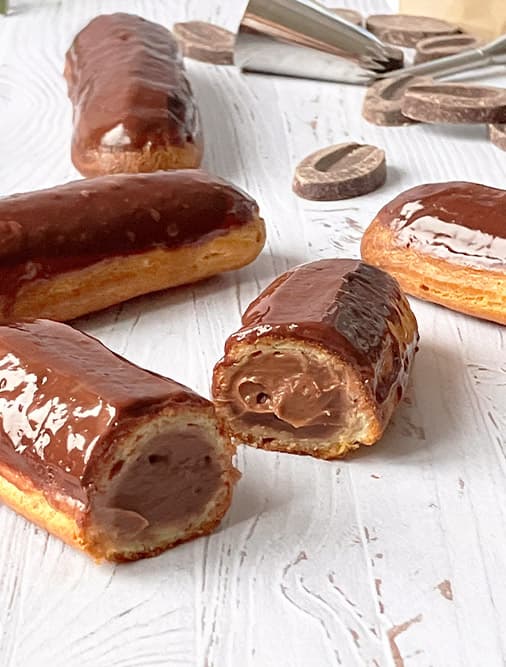
Grand Cru Dark Chocolate Éclair
Piped choux fingers, 66% dark chocolate pastry cream and high-gloss bittersweet chocolate fondant glaze
Heritage & Historical Context
A monumental titan of French pastry counters, the éclair ('lightning flash') owes its name to how rapidly it is devoured. Mastery demands an unyielding straight choux casing baked dry inside to resist sogginess, packed with intense plantation dark chocolate pastry cream and crowned with a glossy, non-tacky fondant glaze.
Evolving from the 19th-century 'pain à la duchesse' refined by Marie-Antoine Carême, it adopted its sleek finger silhouette and the name éclair around 1850 in Parisian patisseries.
Step-by-Step Laboratory Protocol
4 stepsPiping straight batons with fluted tip
Pipe 13-14 cm batons onto lightly greased sheet using fluted tip PF14. The micro-flutes provide expansion channels, preventing unsightly bursting during baking.
Baking and drying the shells
Bake at 180°C for 30 minutes, cracking oven door for the final 5 minutes to release all steam and dry hollow interior.
Filling through three underside ports
Pierce 3 small holes along bottom shell with needle tip. Pipe smooth chocolate cream until the éclair feels reassuringly heavy in hand.
Dipping in tempered fondant glaze at 35°C
Warm fondant over double boiler strictly to 35°C-37°C. Dip éclair crown in one continuous sweep, swiping excess glaze off edges with clean finger.
Chef's Technical Rules
- Never heat fondant beyond 38°C: overheating breaks sucrose crystals, rendering the glaze matte and brittle.
- Using a French star tip (PF14) rather than a round tip ensures evenly grooved expansion without side ruptures.
Troubleshooting & Solutions
| Symptom | Root Cause | Corrective Action |
|---|---|---|
| Fondant glaze turns dull or cracks after cooling | Fondant was overheated past 40°C on the stove | Control strictly with digital probe and hold between 35°C and 37°C |